
Infiltration Testing
BRE 365-compliant testing
Our infiltration testing service helps you assess the infiltration potential on site, informing your drainage strategy and design.
Rated Excellent on Trustpilot


Our infiltration testing service helps you assess the infiltration potential on site, informing your drainage strategy and design.
Rated Excellent on Trustpilot
Infiltration testing (sometimes referred to as soakaway testing) assesses how effectively water drains into the ground. It’s commonly required to support drainage strategies and design for planning applications.
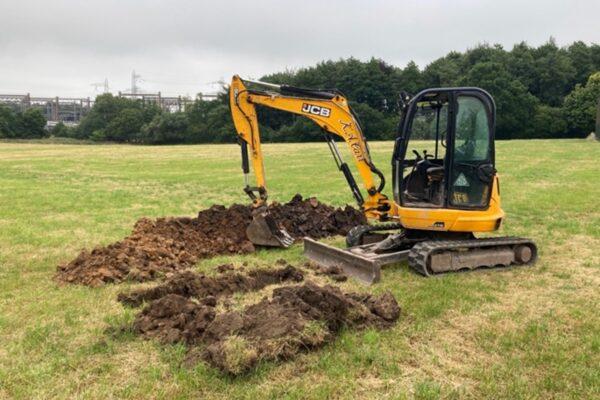
Testing is typically carried out in accordance with BRE Digest 365. This involves excavating one or more trial pits, filling them with water, and monitoring how quickly the water level drops over time.
The results are used to calculate a site-specific infiltration rate, which is essential for designing and sizing drainage features such as soakaways, infiltration basins and permeable paving in line with current standards.







We can support you throughout the entire drainage process, from sustainable drainage assessments to drainage design drawings.
Infiltration testing is often required by Local Authorities during this process to prove if infiltration to ground is feasible.
Can’t find the answer? Our team is here to help.
If you’re submitting a planning application for a new development, drainage will likely need to be considered, with Local Authorities encouraging sustainable drainage.
As per the national drainage hierarchy, infiltration to ground is the most preferable drainage strategy, as it mimics natural processes.
On-site testing will likely be required if you’re proposing infiltration to ground for your development to prove that this is feasible. It will also inform the drainage design.
Testing involves excavating a trial pit on site, filling it with water, and measuring the rate at which the water drains.
Multiple tests are undertaken, with the lowest infiltration rate used to inform drainage design.
Testing should follow BRE Digest 365 guidance.
This is the standard guide in the UK for infiltration testing procedure, soakaway design, drainage construction and rainfall values.
It’s highly recommended a sustainable drainage strategy is undertaken before any on-site testing takes place, especially if you’re submitting a planning application.
SuDS strategies assess the site and proposed development using geological datasets, giving you an initial idea on whether infiltration to ground could be feasible on site.

Designed to assess flood risk from all sources with clear mitigation measures.
Flood Consequence Assessments >

Phase 1 contaminated land reports assessing whether a site has potential contamination, stating who or what is at risk and outlining solutions available.

“The service provided was efficient and friendly. From the first phone call to GeoSmart they provided a clear, professional approach to my request within the timescales advised. Great service and I would have no problem recommending”
“We are very pleased with the service provided by GeoSmart. Their reports have been used to assist with numerous planning applications and have always been delivered to budget and on-time, much to our clients’ appreciation. We look forward to working with GeoSmart on future projects.”
“Efficient and friendly service, GeoSmart provided a clear and concise report within the timescales advised. Great service and I would have no problem recommending”
“The service for a Phase 1 Contaminated Land Study was excellent, fast and efficient! GeoSmart were willing to assist despite the extremely tight timescale to work with. We will definitely consider using your services again”
“The service was great, fast and efficient. Everyone we talked to was very helpful and the details were well received by the planners”
“Great service! Extremely fast and the report was very detailed and well received by the planners. Many thanks GeoSmart, we will definitely use your services again”
“Everyone involved from initial approach to receipt of report was knowledgeable, efficient and focused”
“I would like to say that dealing with GeoSmart was a seamless experience from beginning to end – thank you for that”
“We were impressed by the speedy, well-informed service and personal contact that we received. The report was thorough and comprehensive. We will certainly use GeoSmart’s services in the future”
I was concerned to find out that my house was at a ‘moderate risk’ of groundwater flooding. I was unable to get any further information from anyone until I contacted GeoSmart. The staff I spoke to were friendly, helpful, efficient and extremely knowledgeable. The information provided was very site…
I now purchase GeoSmart’s Groundwater Flood Risk maps regularly – always a very speedy response to the both the initial request and, more importantly, delivery of the data! Excellent customer service too. The data is clear and extremely useful for flood risk assessments.
Brilliant customer service.
Browse our catalogue of white papers, technical guidance notes, and recorded CPD sessions. Each resource is available for individual download.